
Afrinewsia
‘“Trees dey talk o,” she would say. “Dem dey talk about bad-bad things wey go happen for future.”’

‘“Trees dey talk o,” she would say. “Dem dey talk about bad-bad things wey go happen for future.”’

"Our way of life is no longer sustainable, if we want to survive we have to adjust to the world, adapt and embrace it. For thousands of years humanity has tried to shape the world in its image. We failed and did so much damage to the world in the process. Now, we pay it back."'

Set in a coastal region, the story explores how marine technologies, specifically the use of energy-intensive drones for precision kelp monitoring, undermine the very benefits they aim to deliver.

The futuristic city becomes a utopian gaze, setting the stage for us to rethink and see urban planning as an intrinsic aspect of climate justice.

A story that explores the interaction between African medicinal knowledge and Western medicinal knowledge

"Empathy Surplus Disorder? The droid felt cheated. The journalist had twisted and manipulated its words. It felt enraged."

'“Of course, in order to democratize ECP, we’ve had to make certain concessions,” he said. “It’s like the difference between flying Business and Economy. Sure, those up front have a little more legroom, but we’re all still getting to the same place.”’
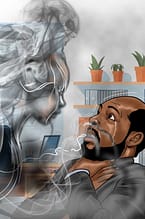
The story features an ambitious young environmental studies graduate, who is keen and eager to bring change but her dreams are shattered by state corruption and climate injustice.

This story is centred on Eketi, whose career as a journalist hit a dead end, forcing her to take a fellowship she earlier won as her only alternative for immediate survival, as she ponders her way forward in life.