

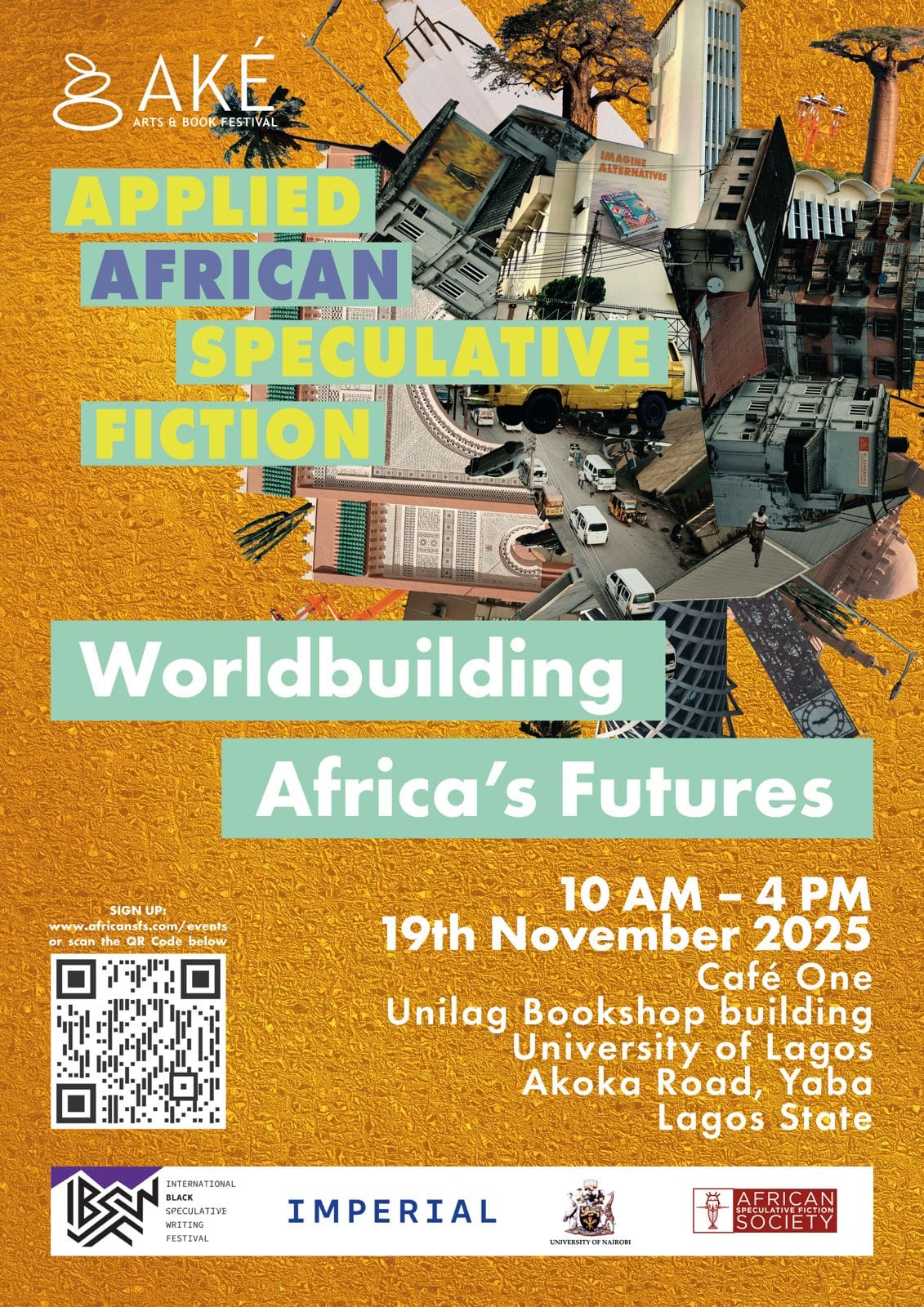
Our project has been invited to take part in the Ake festival, 20-22nd of November, and to deliver a worshop on the 19th of November at the University of Lagos on applied African SF. The workshop took place in person and will be based around the beta launch of the applied African SF toolkit. It featured creative writing and STEM, derisking research through fiction, and an introduction to serious games via Imagine Alternatives. The workshop description and materials are available below. Read a response article to these events in Our Nigeria News Magazine by Jerry Adesewo, one of our workshop’s illustrious facilitators.
Muna Khogali, a director of African SFS, introduced the workshop (you can watch an excerpt here):
Scientific Worldbuilding in Creative Writing (small group workshop plan)
How STEM and authors can work together to deliver speculative fiction better anchored in science, and to think about the future in more imaginative ways in order to shape it*.
This is a practice-based workshop where all attendees will be creating characters and fictional narratives. At the end of this session, each group will share their activities with the group. Each participant would have developed a framework for a Science Fiction story that they may wish to develop further alongside the Applied African SF program or individually.
The main takeaways of this session are:
- How to use science in your writing
- How to develop characters and storylines
- How to collaborate with authors or STEM researchers
This will be delivered through themes and prompts on subjects.
- Themes: AI, Climate, Marine Life, Fisheries, Water, Pollution, Food, Currency, Smart Cities, Health & Care
Facilitator Notes
| Step | Time | |
| #1 | 5 min | Break into groups with facilitators to develop SF story |
| #2 | 10 min | Groups quickly decide where and when their stories take place. They choose a theme. If they can’t choose quickly, assign a theme. |
| #3 | 10 min | As a group, imagine your characters, discuss the implications of a new technology or event. How has the technology made things better? How has it made things worse? (Optional extra prompts: Does it function as expected? Does it sometimes malfunction? Do some people use the technology in creative ways? What happens behind the scenes to make the technology possible? What side effects does it have?) |
| #4 | 30 min | As a group, imagine your characters, discuss the implications of a new technology or event. How has the technology made things better? How has it made things worse? (Optional extra prompts: Does it function as expected? Does it sometimes malfunction? Do some people use the technology in creative ways? What happens behind the scenes to make the technology possible? What side-effects does it have?) |
| #5 | 5 min | As a group, create a title and logline |
| Themes: Climate change, just transition, Water, marine life, or fisheries, Pollution, Food and agriculture, Finance and money, Alternative economies (e.g. post-capitalism), Smart cities, Healthcare and social care, Policing and justice | Optional additional technology prompts Fog harvesting or small-scale desalination, precision fermentation, programmable money, urban agriculture, telehealth, AI-based autonomous multimodal public transport, bio-based building materials, community-owned internet, co-operative fab labs with open-source tools and repair cultures, AI-enabled participatory governance tools, neighbourhood-scale digital twins for energy, water, and waste planning |
Derisking Research through Fiction (small group workshop plan)
How can fiction and stories assist in assessing and developing policy, invite better research questions, inspire activism/advocacy and serve as a teaching tool?
This is a mixed workshop that includes facilitation, presentations, and group sessions, where participants will use fiction in a STEM context. The aim is to demonstrate how fiction can support a more cross-disciplinary approach to research and the teaching of research methods. The workshop will introduce five stories from the Toolkit we are developing, which is essentially a database of ‘useful’ stories, organised by theme questions, and accompanied by suggestions for facilitating group discussions, modelled on the small group seminars that have been running at Imperial College and the University of Nairobi, starting in 2024.
The main takeaway from this session is:
- Demonstrate how African science fiction can be utilised in STEM educational settings at the University of Lagos and beyond.
- How to use fiction to illustrate your critique of science and technology to a wider audience outside the confines of academia.
- How to use fiction to expose, navigate and remedy the power imbalances and marginalisation of research/knowledge between the global north and global south.
At the end of this session, each participant would expand their understanding of how to use fiction in research. We broke into groups of about five each, assisted by a facilitator, and discussed the stories below using the suggested prompts, followed by a group discussion.
- “The Algorithm” by Mwende Ngao – word count: 3707
Themes: data, modelling and power, traditional knowledge, systemic injustice in climate policies
Facilitating prompts (feel free to make up your own questions or solicit from the group):
- Consider real-world examples where we are outsourcing decision-making /transferring power to people who build and deploy models.
- How does this story exemplify the different outcomes of natural disasters due to warning systems?
- Consider the growing role of weather attribution models and their dependence on historical data (when the data is lacking, the models cannot confidently attribute events to climate change) in terms of legal routes towards reparations, distribution of loss and damage funds, insurance markets and adaptation planning.
- Discuss the possibilities of integrating AI and traditional knowledge: what are the risks and opportunities?
- How does the story aid understanding of the issues of representation in modelling? Who builds the models that are used? Where? Who funds it? What data goes in? Whose knowledge defines the models?
- To what extent are bodies like IPCC a bit like the mafia?
- How can this story help us think about regulation (of AI)?
- “Embers” by Wole Talabi – word count: 2412
Themes: Petrocultures, just transition, energy futures, green innovation, climate change
Facilitating prompts (feel free to make up your own questions or solicit from the group):
- What are the different aspects of ‘just transition’ that “Embers” helps us visualise?
- What would just transition look like from Uduak’s perspective? Within the world of the story, what would have to change?
- How is community’s agency portrayed in the story vs. that of corporations (both defunct and ghostly oil one and the new Japanese one championing climate crisis solutions)?
- How does the story highlight the gendered aspects of petrocultures and the gendered impacts of transitioning away from fossil fuels?
- What makes the spatiality and temporality of the technological change depicted in the story terrifying, despite the fact that the direction of change (solves climate and energy crisis) is entirely positive? The technology is a Japanese invention that transforms economies around the world with unprecedented speed. Is this realistic? How can we build resilience to protect people like Uduak in the world of the story?
- “Where there’s smoke” by Chyna Cassell – word count: 4797
Facilitating prompts (feel free to make up your own questions or solicit from the group):
Themes: Climate justice, reparations, climate debt, maladaptation, power of satire
- What happens when innovation ignores justice? How can the voiceless be heard in unjust societies?
- How does this story reflect real dynamics in climate change politics between the Global North and South?
- What alternative technologies would you propose to build resilience while upholding the integrity of the people?
- Can you think of some examples of technologies or policies similar to the heat redistribution project in your country?
- What responsibilities do scientists and policymakers have in proposing climate solutions?
- How does the story’s world compare to the climate change realities of your country?
- “Afrinewsia” by Yazeed Dezele – word count: 2698
Themes: Green colonialism, cultural change, ecofascism, power of satire, conservation
Facilitating prompts (feel free to make up your own questions or solicit from the group):
- Can recycling be wrong?
- Can protecting nature go too far?
- What is green colonialism and how can it be resisted?
- Define eco-fascism. Should nature have greater rights than some humans?
- How far can you imagine our values changing?
- If an eco-authoritarian state were to arise on the continent, where would it be more likely?
- Can this story (or SF stories) be a tool similar to a Necker Cube? A device in philosophy that helps you see from a totally different angle (front to back, which side are we facing?).

- “A Little History of Things Lost and Found” by Shingai Njeri Kagunda – word count: 4700
Themes: Resilience and resistance, ecology as history/culture, colonialism and conservation, solastalgia, ecofeminism
Facilitating prompts (feel free to make up your own questions or solicit from the group):
- How is archaeology portrayed in the story and is it relevant to contemporary research?
- Consider this quote, “The things that were never lost, we hid well.” in relation to data or research colonialism today. What should stay hidden? What can be shared?
- What insights does the story offer on carbon offsetting? Consider this set of conflicting perspectives for context.
- The trees render many services in the story, which resonated with you most? How does this story make the concept of ‘relational values’, ‘existence values’, ‘use values’ palpable? Ecological grief vs. nature as a healer.
- ‘We watched you give us away in pieces in service of your gods. Hiding your treachery behind “national development”.’ What else are we hiding behind “development” rhetoric?
- ‘Heh, cities are not built for being.’/ ‘The forest is always grieving.’ — Are ‘green/sponge/eco-cities’ the answer?
- ‘ Reconciliation requires more than words.’ What does it take? How do we reconnect to trees (nature)?
- Cyclical nature and lineage. Passing down mementos and medicines/recipes
- Nakedness as protest, bad actors (what happens when we turn on our own)
*For facilitators, here is the full workshop that we ran for stories that the applied African SF project commissioned, which were written in collaboration with scientists and other researchers.