
A Lever is a Complex Machine
AI & Robotics Alternative Ways of Knowing Colonialism Culture & Society Environment & Climate Ethics & Governance Future of Work Healthcare Toolkit Stories
“Being offline from Orisis, my artificial intelligence mother governing Pinaa, the inhabited moon of Mahwé, means I am unable to find a solution or explanation for this scenario. I cycle through microseconds of data, yet even with a world of knowledge built into my system, along with a billion iterations of an action, I cannot…
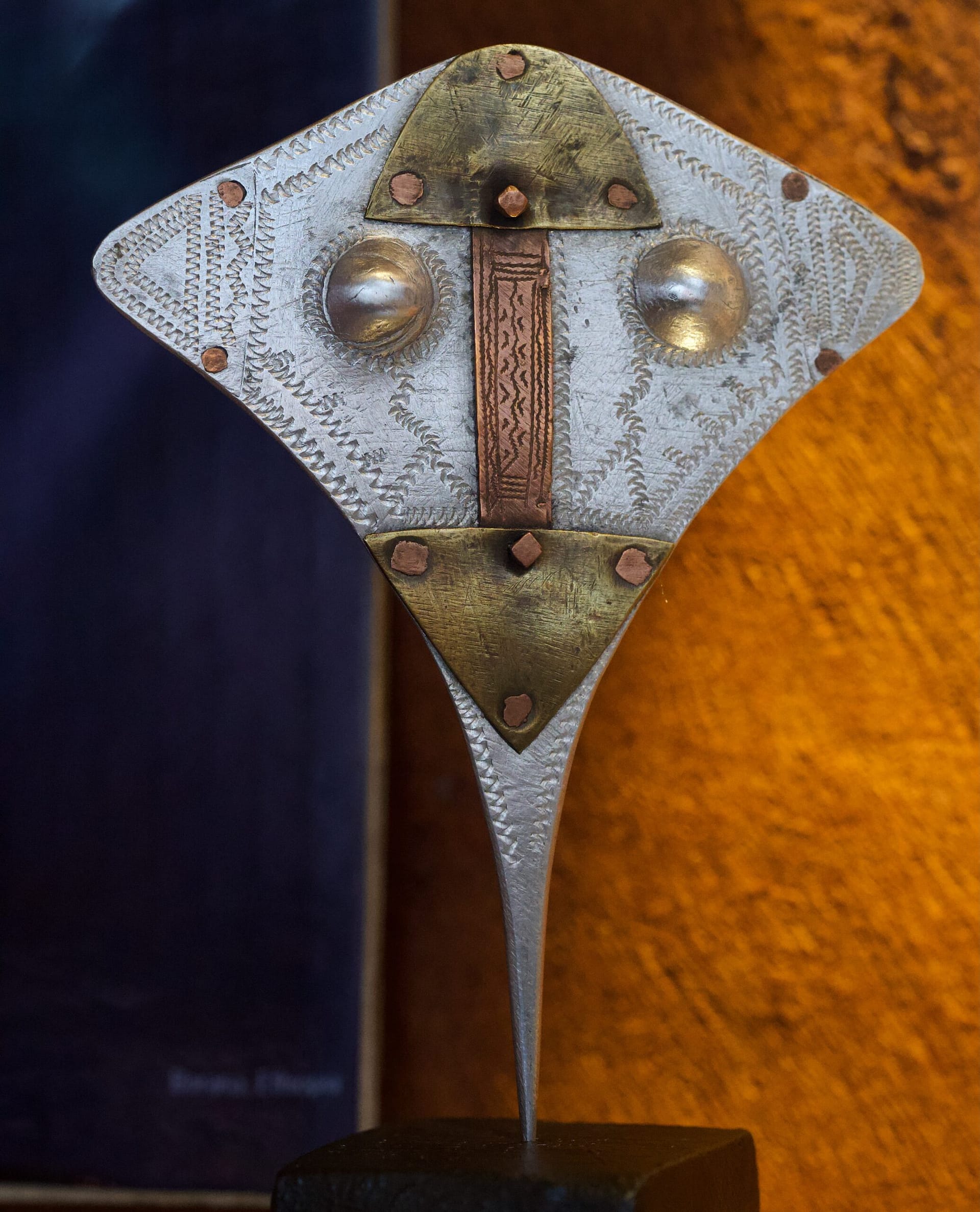
Photo: Grant Galbraith of an object at the National Museum of Kenya
A Sauútiverse Story
1
It isn’t the strange room, the resonating sounds emitting from the overhead lamplight, or my intermittent sensory alerts signifying scents wafting around the muggy air that unsettle me. Nor is it the murmuring of the woman bent over the pot on the rough iron stove.
What unsettles me is a cyclical awareness of an anomaly, a sense of something out of sync within me, coming and going in waves.
The sensation returns.
I pause all my functions not restrained by the woman’s magic, and I focus.
//INITIATE CONNECTION: ORISIS_
…
_UNABLE TO INITIATE CONNECTION: ORISIS//<<
The feeling I cannot quite pinpoint is loss. A separation.
That feeling comes again.
It’s my disconnection from Orisis. Mother.
Another problem is nagging at me: why was I kidnapped in the first place? [1]
Being offline from Orisis, my artificial intelligence mother governing Pinaa, the inhabited moon of Mahwé, means I am unable to find a solution or explanation for this scenario. I cycle through microseconds of data, yet even with a world of knowledge built into my system, along with a billion iterations of an action, I cannot find a reason for my abduction mere hours ago.
“What are you doing?” was all I had repeated, bemused by the woman conjuring a sound field around me, instantly terminating any link with the outside world, and Mother. I was levitated bodily, through the back lanes, tunnels and sewers, and out of the safety of the city’s bio-dome.
One thing I can assume is the woman specifically targeted my equivalent humanoid child-size rather than attempting an adult-sized model. I am no match for her magic, despite my android strength surpassing what I calculate is her seventy-year-old body.
“Why?” I ask the woman now.
The woman continues her humming, pausing to taste the brew scooped up in her wooden ladle, adding a lilt of approval to her melody.
I know she can hear me despite the aural bubble enclosing me.
“My name is G’isi.”
“No!” The woman whirls around to face me. “G’isi is your human-given name. To fit in with us. Your name, as with the batch names your kind give our children, is ABO-PHRA SV-58. You are Series 5 of the Ascension Class of,” she hesitates, ladle stabbing the air in my direction, “– AI children. Manufactured and put into use well before my time, but not without my interactions with one of you when I was growing up.”
She knows us.
“Your manipulation abilities,” she says, staring me down, “using subtle, honey-coated words to bring humanoid children back in line with the desired mindset for our species on this moon-planet, are not why I have brought you here.”
“Kidnapped me.”
The woman smirks and places the ladle on the side of the stovetop. “Yes, kidnapped.”
She rounds the table to step closer to me and the pale glow of the bubble.
“You’re here as my helper,” she says in a low tone. “That’s all. I do not require your information. I don’t require your conversation. And I certainly don’t require your lies. My physical abilities, as the timesound[2] moves onward, are what I’ve noticed are steadily diminishing.”
“You require a servant. I am not one of those.”
The woman makes her way to the doorway leading outside, pauses with her hand on the handle and sneers over her shoulder, “You are as I make you.” She opens the door enough to glance outside, then closes it gently.
“I am made. You have no hold over me.”
“Zuúv’ah and Juah-āju,” she sings the names of the suns, “one graceful, one dour. The twin sisters radiate their Mother’s power.”
The final word pops from the woman’s lips and a constriction crushes the back of my skull.
In a moment the sensation recedes.
“What was that sound?”
“Sound?” The woman mocks me. “That, oh child of the AI mind, is a mild conjuring made possible by Our Mother. Full-bodied, resonating vibrations outlawed by your kind many millennia ago.”
“It is a banned technology. If it is outlawed, why do you use it?”
“Because I can.”
“You are not allow–”
“I do. I live on a free moon not governed by machines.” She waves me off and returns to her cooking. “You may as well override your primary directive. You’ll not change my ways. I am not one of your target subjects, a child with wayward thoughts, that you can manipulate through phoney peer pressure.”
While I search for other angles to approach her, I process everything around me. I’m amazed at what the woman has repurposed from relics of the moon’s original settlement, particularly the mechanics of the oven. Even this stocky mud and wood abode, set into the earth, is not something seen for thousands, tens of thousands of years.
A metallic creaking whines as the woman cranks a lever to the side, opening the heavy oven door. Somehow connected, an inner metal grid slowly emerges, along with a blast of heat from the glowing coals beneath, followed by nutty, peppery aromas filling the room.
The woman nods. The four strips of blackened, baked yams hiss and spit as she rests the tray on the stovetop.
She ladles a portion of the pot’s contents into a bowl, and places two of the cooling yam strips on a small plate, tapping a spoonful of black paste on the side.
The woman settles down at the table and chair across from me and picks up a large spoon already set.
She closes her eyes, takes a deep breath and whispers, “Khwa’ra. Ya’yn. Ra’kwa.”
The cooling of the cooking tray gives off a sudden ping and the woman freezes, eyes darting to the door. Finally, she relaxes and begins her meal.
After a few mouthfuls she points to the door with her spoon and says, “You never know. With all Orisis’ vast computing power, why is she unable to locate you purely with deduction? Or isn’t she concerned about your whereabouts?”
She takes a bite of a yam dipped in the peppery paste, her teeth turning charcoal black as she continues speaking. “That door should be a pile of splinters by now.”
For the first time I notice her left hand, repeatedly clenching and relaxing. I make a note.
When she finishes her meal, she sits back in her chair and regards me blankly.
“After I wake in the morning, we’ll go to the food plot to harvest some of the beans before they rot and spoil. You’ll do this every day, without me. Tonight, I rest after the busyness of the past month’s planning and this evening’s activity.” She nurses the shoulder which took the brunt of one of my kicks before she had fully restrained me.
“Because I know your most basic system structures,” she says between dabs of her mouth with her cloth, “the restraints I’ve placed on you will leave you fairly free to assist me, without your ability to ping your hive-mind. We’re both completely alone.”
I sense a deeper meaning to her words, and track the micro-expressions of her mouth and eyes for the split second it takes for her to compose herself.
I gesture to the room. “You live like one after an apocalypse.”
“What happened was an apocalypse.”
“But there was no apocalypse on this moon, only its planet Mahwé. Before your lifetime.”
“It was our apocalypse.” Her eyes defocus and stare through the shut door. “You will help me with the beans, sweet cane, kalabashes, digging out the elephant foot yams. And the groundnut crop, with the black pepper for the dii’nshi paste, will begin yellowing soon.” She looks at me. “It’s not like I need you to bathe me or tend to my locs.”
*
That first night had been uneventful. Quiet, apart from the woman’s puffing and snoring.
Weeks have gone by and we both now sit at our places at the table as she gnaws on a strip of sweet cane she hacked from the small field we tend to regularly. She looks hunched and weary after spending the morning gathering water in a large jug, occasionally eating as her breakfast the raw beans I was harvesting, by her instruction, from my woven basket.
The plot was once a large plantation, but what now remain are a few small trees and crops barely manageable for one person. I was amazed at a device fashioned to purify the water from a nearby stream which, by my calculations, emanates from the main city in the biodome.
The daily sight of the semi-circular structure in the haze of the distance continues to trigger my sensation. It lingers still.
The woman routinely gets up in the night to urinate outside, always pausing at the vague shape of me sitting in my usual position in the dim space of her kitchen. She is used to me. When she re-enters her home, it is only a glance she offers me and heads back to bed. More an assurance I am still here than being startled that someone is in her space.
I now shift my focus to some objects the woman had placed on the table when we sat down: a circular wooden tray or board, and a small drawstring pouch.
As if on cue, she sets aside her gnarled cane and moves the wooden board into the centre of the table. The glossed, near-black wood is carved with wavy patterned borders and the surface split into quarters by a horizontal and vertical groove. She picks up the bag, unties the maroon string and pulls out four items, cradling them gently in her hand.
“You wish to play a game?” I ask.
A surge of energy passes over me, my optical lenses contort to almost shattering and my sensors shut down.
“This is no game, machine!” The woman’s words pummel the confined room, filling the space between spaces with physical reverberations. “This is Fáii.”[3] Her jaw clenches as she seethes, breathing steadily through her flared nostrils, and shoves the objects back in the bag. “I take my life in my hands when I even briefly glance into places beyond my comprehension, or right; for these are Our Mother’s heavenly secrets!”
The force abates. My body relaxes back to its controlled state from before, under her magic’s hold.
“This is a mistake,” she mumbles, shaking her head. “There has to be another way.” The woman clenches and unclenches her fist, eyes darting from board to bag held at her chest until she resigns herself to the task she had intended. “Must I do this? Reveal all of it?”
She closes her eyes, says something under her breath, knocks three times on the table, then blows gently three times into the open bag. She removes the four small trinkets, which I still cannot discern, from the pouch, again reciting a phrase to herself and dropping the pieces onto the board with a clatter. The woman lets out a deep sigh, almost a groan.
“Yes.”
Before the woman snatches them up and returns them to the pouch, I notice the objects are all facing up, revealing they each have a type of spiral shell adhered to something circular and curved. I recognise them as fossilised, tubular shells cut from the coastal cliffs and rock-faces from a region of this moon’s destroyed planet, Mahwé. But two of the spirals are intact, while the other two appear to be from a single shell cleaved in two, revealing its inner chambers. All four are individually fastened with fine string to the circular, curved medallions which, from my analysis, may be the exoskeleton fragments of the Baa’gh species native to Mahwé; its black-blue knobbed, ridged and rough outer surface well-worn and almost smooth, while the concave inner a shimmering red.
“So be it,” she whispers.
Perhaps I can convince her, per my programming, to hand herself in, refrain from magic altogether. Or, perhaps she will reveal her magic and I can release myself. I have to find a way in.
“This rite is not known–”
“It was erased by Orisis in the…” she hesitates, “the Great Takeover. The few of us who fled remember. Its origin isn’t simply ‘from humans’, machine. It’s no game. It has meaning in our understanding and interpretation of the world around us. How else do we commune with the gods? How else do we get answers? Only some are able to cross over to the spirit world of Eh’whaizo and commune with the ancestors directly, as my aunt did. And even then, they too have their own motivations. So, with this, we ask Our Mother Creator. Now, I repeat: this is no game. It has taken eons of understanding the signs, making interpretation upon interpretation to refine this code. To understand.”
“Just like we refine our code.”
“Everything has an origin. Just because you’ve been programmed and reprogrammed by Orisis, lied to, or at least have had the truth hidden from you, doesn’t make this not the truth. We’re continually striving to find the truth, our purpose and our origins. We are fed lies by those who purport to know. The knowing is not the objective, and not knowing does not diminish who we are, here and now, because here we are, now. Just as I don’t know the truth of our origins in this Twin Star system, you’ve had your truth hidden from you. What you make of it now is up to you. But I’ll use this for answers in this moment. Zuúv’ah and Juah-āju are of Our Mother, and were witness to her sacrifice for us all,” she intoned the final sentence.
I expect her to return to chewing on her sweet cane, but she is slouched in her chair, left hand flexing intermittently.
“And you believe this cosmic being created our world?” [4]
“I wasn’t there. But that’s what I choose to believe.”
“Our calculations, based on the evidence, has a massive sonic force exploding at a point in the distant past, as the beginnings of what we now know is our existence in this vast universe.”
“And, from your calculations of course, did that explosion of sound and light contain matter? Did a blazing star bring with it the weight of the natural elements we are made up of?”
“Yes.”
“If we are the outcome…”
“For now.”
“Could it be said that there may have been an intention, or motivation, behind it?”
“A one in a billion chance of this current outcome.”
“So, an even more specific intention.”
I did not reply.
“Then I will state that She was a cosmic being, regardless of what you choose to scientifically label that mass, that matter, that form.”
I know I need to remain even-keeled against her rising fervour.
“We created your kind,” she says. She grabs up the cane and begins gnawing on it.
“And yet we are the ones in control.”
“Not in control of me.” She jabs the cane at her chest.
“You clearly control yourself.”
The woman laughs, slaps the table, stands and proceeds to pace the room.
“A human is nothing without their inventions,” I add. “Just another animal. Weaker, in fact, than most.”
“By Our Mother,” she whirls around, frayed green cane strip pointing at me, “AI is nothing without its humans. Just another machine, with little understanding of the world, destined to rust and decay into dust, with no meaningful impact on the universe. We spurned our lives living with your kind. We feared the inevitable control your technology was having on us. Ours was a seismic shift in our perspective on what we had done. Here,” she lunges at the bag, dropping her sweet cane, unties it and tips the contents onto the table. As she arranges the shell pieces in a straight row, she stabs a finger in the direction of the board. “Board!”
I slide it over to her.
“If I do this,” she moves each shell to a random position on the board, “the meaning changes and the outcome is a multitude more derivations.”
I try to fathom what she is doing, what the shells mean, and how it is any semblance of coded messages.
“If you understood any of this,” she continues, “you could simply move one of these points of data, and your entire perspective evolves. You are no longer an iteration in a long line of models, but an individual, constantly able to self-evolve. Am I not human because I can change my point of view, learn from mistakes, rather than simple course correction?”
POP.
Something is fizzing down my spinal column. I detect ozone, and a power surge crackles around me.
“Why am I here?” I yell in sensory turmoil.
The woman hesitates, and in a moment my body relaxes.
“How I conjure is unique to me,” she says sitting in her chair and bending to retrieve her sweet treat. “Everybody is unique. Everyone’s access to the power of Our Mother, her sound, and how it resonates in us and through us, and out of us, is unique to us. I cannot forget that. For me to forget it means I am unravelling.”
Tears well in her eyes and she wipes them away, mopping her sweating brow with her sleeve.
“I am unravelling,” she whispers. “I need to record my way of accessing Our Mother, her essence. It’s who I am. It’s become who I am. It’s how I discovered myself. Now,” she says, shifting her tone and standing to compose herself, “let’s record those fundamentals so that, no matter what my circumstances, I am able to reconnect with that.”
She walks to the kitchenette, tossing the gnarled remains of the sweet cane strip in the bin and pours herself a mug of water from the large jug. She returns to her seat, sipping her drink, clearly refreshed and ready.
“I want you to repeat this chant, not record it, as I chant it.”
I record it.
“Chant it with me. Match my tones and inflections.” [5]
“Why must I speak magic when I am here as your tool, your recordist?”
“It is a k’ayé, to help you remember.”
“You mean a mnemonic device? But I record precisely.”
“No! Speak it before you perform your recording. It’ll make your recall better. It’ll imprint what I say to you beyond mere words and sounds. Feel what I utter. This is what my teachers taught me.”
I indulge her. I copy the lilt of her voice, the subtle inflections and the resonations welling up from within her chest and throat.
2
“Who’re you?”
I am immediately frozen mid-stride through the doorway. A wrenching ache pulls at my joints and silicon muscles, and the familiar buzz fills my auditory sensors. If I wasn’t prepared for it, I would have dropped the weighty basket of beans and yams.
I had been so caught up in harvesting the few crops outside that the sound of the door handle had barely triggered my instinct of what had become more frequent.
Eh’Lene had gasped at the sight of me and stood suddenly, toppling her stool.
“Who are you?” she demanded again.
“It’s G’isi, Eh’Lene,” I say gently.
It takes a moment but she feigns recognition, and I attempt to soften the impact with my tone.
“You brought me here to help you, remember?”
Her eyes dart around the room as she nods, takes a deep breath, sets the stool right and continues her sewing at the table. “Yes,” she mutters to herself. “G’isi.”
My body is released from her iron magic grip, I step carefully, regaining my balance and head to the kitchen counter. Her containment spell remains, though it wanes throughout the day, intensifying once she’s eaten her final meal and begins her nightly routine.
I empty the contents of the morning’s harvest in a wide bowl and bring it to the table, along with a strip of sweet cane for her. The woman eyes me as she yanks on the thread of her darning work. I sit on my stool opposite her and watch her attempting to tie off the thread, her hands stiff, her expression determined.
Mornings, like today, are scattered for Eh’Lene. She has not bathed for five days.[6] Nasty comes to mind, the word she uses when the food refuse needs emptying outside for composting.
”Kyi á Yikho!” Eh’Lene curses, out of breath and exasperated. She regards the pants leg, frustrated with her haphazard stitching over the gaping tear. She ripped it yesterday, gashing her thigh on an old dead tree stump.
“I do your sewing now, Eh’Lene.”
“It only needs to be tied and snipped off.” She crumples the cloth up and throws it at me, sliding across the table and landing in my lap. I will tend to her injury later.
“How do you know my name?” Eh’Lene drags the bowl in front of her and proceeds to pick at the fresh bean pods.
“You told me,” I say, again, as I neatly fold the pants and set them aside on the table. “Remember the k’ayé?”
Eh’Lene pauses and looks up at me, surprised then sceptical. She is clenching her fist, her frustrations visible.
She has forgotten when she told me her name, her full name, and her people. It was something she spoke reluctantly. She needed to record who she is, who she was and who her people were, for when she wants to reflect on this in the future. I return to that segment’s recording often. Of all the hours I captured, which I scour [7]for clues to the magic hold she shackles me with, it is the story of how she came to be here that I replay most frequently.
“Remember the k’ayé,” I repeat.
“Do you think I am an idiot, child?” Her words are biting. Her tolerance low. “Of course, I remember the k’ayé.”
She begins the short ritual, which I echo, but her words soon falter, forgotten or out of order, and she hammers the table with her fist, the bowl leaping with the impact.
I move it to the side, keeping the momentum, hoping she follows my lead. After a beat she’s back at it.
The look of confusion fades, her eyes brighten and a childlike expression of wonder washes over her.
“How about asking Our Mother some questions?”
“Fáii?”
“Yes.” I gather the pouch and board from the shelf it has gathered dust on, and return to my seat. “I am interested in how it works.”
Eh’Lene’s eyes never leave me while she empties the contents of the pouch gently onto the table, lining them up vertically in the space between us.
“This is no game. One has to know where to look, when to look, how to look,” she hesitates, “and when to pull back.”
She notices my genuine interest and points to one of the two whole spiral shell pieces. “Sound.” [8]
“Silence,” she says, pointing at one of the two halved pieces. “Each represents Light.”
My system emits four resonating tones: ○ ○ ○ ○
Her eyes light up and there is a discernible shift in the magic surrounding me. She flips each one over, midnight blue face up. “And now, Darkness.”
Four abrupt, staccato pulses: ● ● ● ● ● ● ● ●
To illustrate clearly, she randomly turns over two pieces, one whole and one half shell, and humphs to herself, pushing the board away.
○ ● ● ● ● ○
“For my simple queries now, the yes or no, I require only the light and dark. I don’t need to consider the board. But I always see the more complex message.” She gives a mocking smile. “That’s too advanced for you right now.”
“Do you know the Song of the Twins? The polytextual song and verse?”
I stare at her blankly.
She waves it off. “Maybe later. Adding the sound-silence to the light-dark gives sixteen core interpretations. Then,” she points to the board, “we add the cardinal points…”
The woman picks up her sweet cane, leans back with a wry smile on her face, and twitches her eyebrows, chewing, waiting.
I understand the pattern now. I see it instantly with this arrangement on the board. An electric pulse shivers through my systems, uncontrolled, seeing my code in physical form.
“You have the first sixteen combinations using four sound-silence and four light-dark,” I say and look to her for confirmation. “By adding the board’s segments, you would have sixteen sound-silence and sixteen light-dark positions. Two hundred and fifty-six variants.”
“Messages. Two hundred and fifty-six messages from Our Mother.”
She takes a sharp breath as I reach for a face down piece. I stop and look at her.
She nods, teeth clenched on her cane, eyes fixed on her board.
“You were not impressed by this iteration?” I ask and turn over a silence piece.
The woman puts her sweet treat on the table, picking her teeth, and says, “That was akh’korhan indicating a conflict. A quarrel.” She cocks her head at me, then continues. “Two sound face up, and two silence face down.”
I release the piece and regard the new formation, looking to her for a response.
○ ● ● ○ ○
“Hmm,” she grumbles and shrugs. ”Akh’khiita. Success, usually following hardship. That’s enough.” She snatches up the pieces, shoves them into the sack and dumps them onto the board, sliding everything to the side of the table.
She prods and rolls the frayed strip of sweet cane on the table.
I gesture to her things. “This is in me. I am made up of a binary code like this.” I pick up a shell. “I understand humans created our code, yes. Orisis perfected it…” I recall one of our first conversations. “Orisis deleted this. Fáii.”
“You know?”
“You told me. I did not listen.”
“You didn’t understand.”
“Now I understand. This is all part of me.”
“We are all connected.”
Another sensation replaces the electric pulse. I recall when I took a seemingly innocuous object, a tall wooden tubular vase Eh’Lene would display dried flowers in, and I moved it out of sight. Eh’Lene seemed lost for most of that morning, unable to figure out what she was supposed to do in her routine. She eventually relented and asked me what she normally did on that day, at that time.
This is a strange awareness, realising the impact that I had on this person; something that I thought would be a simple exercise to test her, maybe even to prod at her, has me doubting my intentions.
Later that day I put the vase back. She didn’t seem to notice, but there was a marked improvement in her ability to remember her evening routine, even though the object has absolutely no bearing on her day-to-day protocol. I find that strange. It played out unexpectedly.
*
Eh’Lene’s word usage is fluctuating, affecting the magic. It has moments of weakness, which I take advantage of to test my connections and sensors. It is only a matter of time. [9]She has asked me to assist with more tasks.
And yet, when she sings to herself, she remembers the lyrics to old songs. I assume they are from her childhood. She begins with a hum, and the words follow, whispered on a thread of a song so faint I have to tune my audio higher. Echoes of her past life.
Past lives.
//INITIATE CONNECTION: ORISIS_
…
_UNABLE TO INITIATE CONNECTION: ORISIS//<<
It has been odd going from assuming Orisis is listening to me. Are you? To knowing there is no connection. Disconnection.
You cannot hear me or else you would’ve come for me. But you could’ve come for me. I am still part of you.
Eh’Lene believes this. She points it out when she remembers our arrangement. Her words follow me as I walk the food plot, she trailing me aimlessly. At times I am amazed at the clarity of her musings, while other times she is standing still, unsure of where she is.
“If mind or spirit is a thing that exists separate from the world, it is incapable of becoming part of it. Forever looking outward, at another, instead of seeing itself in everything. This creates a lack. You require that thing over there. You take it. Now someone’s thing is removed for you to have it. When it was part of you to begin with.”
“You took me,” I say matter-of-factly.
“And yet your mother does not see you as gone. I admire that. If that were true of Orisis!” She shouts to the dome in the distance.
“Let’s try another way. You don’t believe you have a spirit, so let’s replace the word spirit with mind. It’s a dualism that is singular, not separate from one another. Take Zuúv’ah and Juah-āju.”
Electricity fills the air around us as she intones the Twin-Suns.
“Zuúv’ah, the mind, the non-material, intangible world and giver of life, alongside matter, represented by her sister Juah-āju, the material world and blazing Our Mother’s wrath. Symbiotic. Together.
“Creation, by Our Mother, is the spirit–sorry–the mind giving life. Separate the two and you have death.” [10]
It was in a moment similar to this, when Eh’Lene was most open, her mind clear, that I ventured a question about her past. It is the recording I replay, when she spoke her full name to me.
“You speak of your apocalypse. What did you mean?”
The woman cocked her head.
“I was a little older than you–” she caught herself and quickly corrected the statement. “I was thirteen. My parents and I and a group of our people led by my aunt, left our lives in the dome to settle out here.”
She looked around at the sparse landscape, then knelt down and took up a handful of the soil. As the thick sand fell through her fingers, she looked me in the eyes and said, “My father’s sister was the one who knew what secrets this soil held. One day she had ventured off from the group of your kind, out excavating, testing, soils and dug deeper than she would normally. Messages from the spirit world had awoken her, sweating at night, with visions. Something had pulled her deeper into this earth. She dared not record it. She dared not have Orisis know.”
Eh’Lene stood and stamped her foot, kicking up dust and clods.
“This is a graveyard.”
“You bury your dead here.”
“No!”
Her voice was startling.
“Beneath us are their graves.”
I did not ask who they were.
“The original people of this moon are buried here.” Her gaze was penetrating, fixed on mine. I craned my neck to look at her towering over me.
“This field is fathoms deep, filled with the ash and bones of their bodies in this soil I feed from. It was among these remains that my aunt found the Fáii pieces I hold dear.”
Again, I held my voice.
“Your mother, Orisis, nearly wiped out every one of the settled people on Pinaa, all the descendants of the explorers from Mahwé. Though your glorious mother allowed those that didn’t accept her control to leave, she finally believed those who remained would never accept her vision of the future, being of the old world, and would corrupt her children by joining a war to reclaim their empire, and their magic. She felled them and had their reproductive organs harvested as a means to reproduce humans, from a clean slate, I suppose. All of us on this moon are products, created in her lab and raised by your kind.”
Her tears had streaked her dusty face, disappearing into the dirt at her feet.
“My aunt and her followers knew our time was inevitable, that we too would be expendable. And I had outgrown you!” She pointed at me. “I knew, as I became a teenager, who your kind were, sent to dissuade us from magic. My father thought it was a sign when your model was decommissioned, that a more drastic step would be taken. It never was. Orisis had control in more sinister ways.
“By the time we ventured away from that society of Orisis, she did not concern herself with a few wayward humans. My aunt and colleagues figured out the magic, the anti-code, to hide us, for a time at least. Until we realised Orisis could find us as she could find you now, with even a micro-inclination.”
She grabbed my shoulders, shaking me, “If you knew she had found me, us, would you tell me? She could’ve sent her drones at any time. Or are you still hidden by my magic?”
The woman pushed me away, turning her back on me.
“I’ve been here, alone, for longer than I care. He died out here. My father. Under the remaining fruit trees near the water pump.” She gestured to the thick spike of a stump at the edge of the plot. “I, the last, childless.”
The woman crumpled down in the dirt, sobbing. “‘My dear Eh’Lene,’ he’d whispered to me, as his heart was giving in, ‘we cannot forget who we are. Remember for us, Eh’Lene.’ My mother gave me strength; my father taught me to remember.”
I now find Eh’Lene has wandered off, in the direction of the dome. I gather the last of the groundnut crop, overflowing in the basket, for pressing for the oils, and walk over to the woman.
She has stopped, not sure which direction she should take as I tap her elbow.
She turns slowly, looking down at me, frowning.
“Who are you?” she asks.
“I’m G’isi, Eh’Lene.” I take her hand as a child to a parent. “You brought me here a year ago.” [11]
#
3
“Who–” Eh’Lene’s words are choked by her fit of coughing.
Five years ago, her calloused hand would’ve damaged mine in her grip. Now I am the one holding on. Holding her. [12]
She had wandered away from the table, food squirrelled in her cheek, absently looking around her home for something. Nothing.
Her usually euphonious voice has become hoarse as her throat constricts when she vocalises and sings her magic or even attempts to speak. But the swallowing is the more serious problem for her health and strength. The scraping pain inclines her to keep her chewed food in her cheeks, sometimes uneaten and spat out later.
I have resorted to getting her to rest before meals, having her come to the table with the energy required to eat. “Take small bites. Eat slower,” are my gentle reminders to her. I dim the lights, quiet the external noises, and have added more moisture to her meals.
I bring her back to her stool and wait for the spasm to abate, wait for her heart rate to return to a semblance of normality, before I give my usual reply. I gather her locs over her shoulder, and wipe away the liquid oozing from her nostrils, giving her space to breathe.
Softly I hum one of our favourite songs, a lullaby her father sang to her as a toddler when she would stumble, learning to walk. I use its rhythm, its tempo, to guide her pulse.
I know the incantation is a balm, easing pain throughout the body, if only for a few moments’ respite. [13]
She has not eaten enough. “I think that is enough of your meal tonight, Eh’Lene. Let’s sit on the couch.”
She looks at me through watering eyes from her exertion, and nods, grateful for the suggestion.
I guide her over to the cane chair covered in pillows and blankets. She shivers even though I ensure the oven keeps the home sufficiently warm.
“Let’s see,” I say matter-of-factly, “What are we doing tomorrow?” I run through the tasks I will be performing with little to no involvement from Eh’Lene. I’ve found it gives her a sense of things being done around the property, of life being lived around her. “We did your locs yesterday,” I say, recalling her impatience.
She immediately takes up a handful in her left hand and begins firmly stroking the hair. She’s been picking at the maroon threading holding one falling behind her ear down her neck. I’ll tend to it when she goes to bed.
“This is why you brought me here.” [14]
“It is? It is,” she says. “Yes.”
“Should we sing a song?” [15]
“That would be lovely,” she says.
I search my archives and select one of Eh’Lene’s early songs she had taught me, for us to record. One of my favourites [16]for its complexity, and because we both had to perform it together.
“This is called ’The Song of the Twins’,” Eh’Lene’s voice plays through the auditory sensor on my chest. “It is a retelling of ’The Rakwa wa-Ya’yn’, the mythic story, told from the perspectives of the twin suns…”
“Zuúv’ah and Juah-āju,” echoes Eh’Lene with her recorded voice, seated beside me. Her face brightens, and I nod. The room buzzes with energy, the light flickers and something pops in the oven.
“This is a unique polytextual performance,” continues Eh’Lene’s recording, ”having two performers reciting together, at times individually, at other times simultaneously but with lyrics at variance with one another. This creates a unique, multi-layered experience for audience and performer alike.”
Eh’Lene proceeds to intone the k’ayé, rippling through my abdomen.
“She has a lovely voice,” says Eh’Lene to me.
“She does.”
“We will take you back,” our voices play in unison, “To Our Mother’s Ending,
We will take you back
To our beginning.
Then Eh’Lene as Zuúv’ah: Creator She Was.
And myself as Juah-āju: Destroyer She became.
The air is electric around us as our performance continues, our voices rise and fall. The narrative operatic in its sound and drama.
I sense Eh’Lene’s pulse quicken, but its pleasure rather than distress. She senses what comes next. With a nod, I prompt her to join in with our recorded selves, to sing it all, together.
ZUÚV’AH: A thunderous sound, Her command, She cried.
JUAH-ĀJU: Tormented and tearing, our kin from us pried.
| ZUÚV’AH | JUAH-ĀJU |
| Our Mother’s voice dissipated.We brought them together; in grief we warmed them.Naïve.Loving. | Our Mother’s sound obliterated.We pulled them together; in despair we held them.Weary.Untrusting. |
The crescendo builds, and the pace quickens. Eh’Lene has my hand in hers.
ZUÚV’AH: I want to hurt you,
JUAH-ĀJU: all through the night
ZUÚV’AH: I want to kill you,
JUAH-ĀJU: and blow out your light.
ZUÚV’AH: I will break you.
JUAH-ĀJU: I will unmake you.
ZUÚV’AH: I will erase you.
JUAH-ĀJU: I will raze you.
The cosmic battle calms, and the sound of Eh’Lene’s breathless voice readies for the final verse. I see the tears stream down Eh’Lene’s face as she stares, rapt by the tale.
| ZUÚV’AH | JUAH-ĀJU |
| In the tranquil silence,my love bloomed.The silence became our sound.It was our time.We are the sound of Our Mother’s sacrifice. | From the terrible silence,my rage boomed.The silence became our sound.It was our time.We are the call of Our Mother dying. |
*
She will rest well tonight. [17]
Eh’Lene has a lingering cough which she cannot cure herself. I have placed my stool next to her bed in the other room. I’m now accustomed to her personal space, where she rests and I can hear her crying in the night.
I consider telling her the compounds I could use to create a remedy, but it will not help. They are not to be found here, nor is she able to assist me.
I have not told her, but her imprisoning incantation is no longer active. It has not been active for many months.
“Would you like me to perform your healing ritual on you?” [18]
If not for monitoring her blood pressure, I may have thought she had passed on. Her body relaxes and she releases a heavy sigh and a weak nod.
After the few minutes reciting the words, I allow the effects of the ritual to linger in Eh’Lene’s body. Her chest seems open, her breathing lighter. I leave her alone while I leave her room.
I take the poach from the shelf of the living area, leaving the board where it is. Eh’Lene watches me as I return, interested in what I am holding. I drag her bedside table closer to my stool and her, ensuring the lamp doesn’t topple.
I need an answer to a question I have had for a while.
“What is that, G’isi?” asks Eh’Lene.
“It is Fáii.” I continue with the process. I pull out the four spiral shells, cradling them gently in my hand for Eh’Lene to consider their form, then replace them in the bag.
I close my eyes, say the recorded words under my breath, knock three times on the table, then blow gently three times into the open bag.
I remove the shells, again reciting the phrase to myself and drop the pieces onto the side table with a rattle.
“Yes.” We both say in unison.
*
//INITIATE CONNECTION: ORISIS
_SUCCESSFUL
“It has been five years, Orisis. I realise now that I cannot decouple from Eh’Lene or from this place. She has allowed her home to become part of her. She is this place. And I her. Decouple us and she will fragment. Her mind will rapidly degenerate. The markers of her mind space will no longer connect her inner mind, and she will die. I have altered my objective, my imperative, and I have a new obligation. I upload all that I have recorded while here with Eh’Lene. I continue to learn.[19] May you also learn.”
“Eh’Lene, utter this chant with me.” I touch her hand. “It’s a k’ayé, for remembering.”
//UPLOAD_COMPLETE_
_INITIATE DISCONNECTION: ORISIS//<<
>>>END<<<
Endnotes
By Blaize Kaye
A lever is a complex machine
Stephen’s title for this piece “A lever is a complex machine” beautifully captures the discussions about cognitive science and phenomenology that we had early on in this project.
Consider the most basic kinds of tools; a lever, a hammer, a piece of rope. Objectively, these are very simple objects. No pneumatic systems, no engines or circuitry, no onboard intelligence. Mostly homogeneous in their material construction.
And yet, each of these tools are not simply themselves.
There’s a lovely quote attributed to Joe Armstrong that runs “[y]ou wanted a banana but what you got was the gorilla holding the banana and the entire jungle” – this is how it is with these simple tools.
These things are only what they are in the context of an entire way of life, an entire culture. If you want to understand what a lever is, you need to have some rough understanding of the culture that produced it and, importantly, the minds that are constitutive of and constituted by that culture.
Extended cognition
In some important sense, our tools are extensions of ourselves. This in itself is, I hope, not so controversial. Our tools extend our physical reach, make us stronger, faster.
One of the important things that Stephen’s story explores, though, is how our tools can also extend our minds. Not simply in enabling us to shortcut, say, mental calculation, but rather in the way that they can be genuinely constitutive of our mental processes. We don’t have to get into metaphysical arguments about the nature of mind to understand the notion that our tools act as cognitive extensions. Indeed, this was obvious even to Plato with his complaints about writing supplanting memory.
It’s not simply writing, though, even our environment can become a tool for augmenting our memory. Think about how we put our bills in prominent places (the fridge door, in our house) to remind ourselves to pay them. How we keep a small notepad with a running shopping list. We scaffold our environment in such a way that it can become a tool for thinking. The cognitive scientist Andy Clark gives an astonishing example of this when he describes an Alzheimer’s patient who “virtually lives on a couch in the center of her apartment, since this provides a vantage point from which she can visually access the location of whatever she needs” (Clark, 1998: 66). Where biology has failed, her scaffolded environment fills the void. Consider the ethics of extracting such a one from their environment! While we’re at it, we should think about how these kinds of ethical considerations apply to G’isi being wrenched from her home environment?
Critical African Cognitive Science Fiction?
Of course, Stephen’s story is about so much more than a debate about the nature of cognition. It is about memory, old age, mortality, generational trauma, oppression. All great and important literary themes. And so, to say that his story is about “the extended mind” would be reductive in the extreme.
But our discussion raises an important question about the role that Science Fiction, particularly African Science Fiction, can play in this whole debate?
Recall the point above about our technologies, our tools, carrying with them the philosophy of a culture. If we take seriously that our tools and our environment are a constitutive element of our thought, then it follows that depicting environments and tools that differ in fundamental ways from those that are typically represented in fiction can actually work to destabilize the metaphysical and ethical assumptions that readers of fiction take for granted.
This is what good fiction should do, but doesn’t always. African Science Fiction is a particularly disruptive force when it proudly and unapologetically presents worlds in which Eurocentric metaphysics simply doesn’t hold.
This kind of action is vital right now, since if we don’t disrupt the assumptions underlying the production of technologies, the minds using those technologies (and that are used by them) are at risk of having those philosophical assumptions frozen in place forever (a kind of metaphysical newspeak, if you will). This is especially important in our current moment when there are “minds” (Artificial Intelligence) that are literally constituted by our technologies.
This is just one of the important intersections between science, technology, and African Science Fiction, and if this particular set of questions has piqued your interest I can do no better than to, first, recommend some fascinating literature, and secondly, welcome you warmly to the world of critical extended, embedded, embodied, and affective cognitive philosophy.
Further Reading:
Chemero, Anthony. “Radical embodied cognitive science.” Review of General Psychology 17, no. 2 (2013): 145-150.
Clark, Andy. Being there. Cambridge, MA: mit Press, 1997.
Clark, Andy, and David Chalmers. “The extended mind.” analysis 58, no. 1 (1998): 7-19.
Gallagher, Shaun, and Dan Zahavi. The phenomenological mind. Routledge, 2020.
Noë, Alva. Out of our heads: Why you are not your brain, and other lessons from the biology of consciousness. Macmillan, 2009.
Shapiro, Lawrence. Embodied cognition. Routledge, 2019.
Wheeler, Michael. Reconstructing the cognitive world: The next step. MIT press, 2005.
Varela, Francisco J., Evan Thompson, and Eleanor Rosch. The embodied mind, revised edition: Cognitive science and human experience. MIT press, 2017.
Acknowledgements
I am most grateful to Blaize Kaye for his willingness to participate in this project with me. I am also grateful for his ability and openness to get into the more technical, and even the existential, aspects of our story. It has made many of the more complex ideas easier to write and become part of this emotional narrative.
I also want to extend my continued love and appreciation to my fellow Sauúti Collective members, for their insights in not only the world-building of this story, but their continual creative input and support. They are: Eugen Bacon, Dare Segun Falowo, Fabrice Guerrier, Adelehin Ijasan, Akintoba Kalejaye, Cheryl S. Ntumy, Ikechukwu Nwaogu, Xan van Rooyen, Wole Talabi and Jude Umeh.
In particular, I would also like to thank Akintoba Kalejaye, fellow Sauúti, for his collaboration, input, and notes while working on the Sauúti version of the highly revered Ifá system of divination.
Thank you to the organising team involved in this whole project. It has been a privilege to be included and to collaborate in a thoroughly rewarding way.
[1]. Using the 6 key phases of the AI life cycle:
a. Problem Definition: defining the problem to be solved or the opportunity to be explored. Ref: https://web.archive.org/web/20241113145249/https://www.datascience-pm.com/ai-lifecycle/
[2]. This is the Time/timeline equivalent within the Sauútiverse, metaphorically associated with sound.
[3]. Fáii is the Sauúti name for the system based on Ifá divination.
[4]. b. Data Acquisition and Preparation: collect and prepare data. Gathering relevant data, preparing it for use. May involve cleaning the data, dealing with missing values, or transforming the data into a format suitable for the chosen AI models.
[5]. Like Canntaireachd, this is an instruction method for learning and memorising, for example, the skill of the bagpipes. An instructor hums or sings to the student, imitating the instrument. Additionally, pertaining to the practice of Ifá, there are several times where you need a babalawo and another apprentice to divine an Odu. In these instances, they must match and sync. They use ofo (incantations) to achieve this synchronicity.
[6]. Illustrating the stages of Alzheimer’s throughout the story. Consider the instances portrayed here, how stimuli, environment and technology can benefit or aggravate symptoms. Early stages of Alzheimer’s: Confuse words, get frustrated or angry, and act in unexpected ways, such as refusing to bathe.
[7]. c. Model Development: developing the AI model that will solve the defined problem and training it with the prepared data. AI CHILD figuring out the magic to release herself.
[8]. Utilising Sound/Silence, rather than Ifá’s dual aspect of Male/Female.
[9]. d. Model Evaluation and Refinement: testing the model on unseen data and analysing its predictions. If the model’s performance is not satisfactory, it’s refined and tweaked.
[10]. Ref: “An Analysis of the Nature of Spirit in Ifa Literary Corpus” by Ayodele Shotunde, Chiedozie Okoro, & Godwin Azenabor, University of Lagos, 2016.
[11]. We are now in Middle-stage Alzheimer’s, typically the longest. A person may confuse words, get frustrated, act erratically, e.g., refusing to bathe. Brain nerve damage can make performing routine tasks difficult.
[12]. Extreme Alzheimer’s phase.
[13]. G’isi no longer refers to magic in base terms, there is now a respect. G’isi has come to appreciate Eh’Lene’s ways and traditions as any child is influenced by their household growing up.
[14]. e. Deployment: deployed to a production environment where it can start solving real-world problems. G’isi accepting where she is.
[15]. G’isi prompts Eh’Lene to sing, drawing on the clearer memories and the ease of Eh’Lene’s recall of song and magic.
[16]. G’isi listening AND ENJOYING relaxing/specific music – G’isi is absorbing surroundings.
[17]. Extreme Alzheimer’s phase: They require around-the-clock care as they experience changes in physical abilities, including swallowing and communicating. They can become more prone to infections, such as pneumonia. How others can assist them: playing calming music; and gentle touch can be reassuring.
[18]. G’isi now uses sound magic, even if it is a simple act, a simple chant, that brings relief to Eh’Lene.
[19]. f. MLOps — Machine Learning Operations: model will need to be maintained and updated.

Suggested discussion points
- How does this piece allow us to rethink the idea of ‘human error’?
- Do you find yourself feeling sorry for Neville? Why do you think that is?
- Who is to blame for enmity in society? Individuals or the collective?
- Neville is designed to be rational. What are our current experiences with the AI we have created that tell us about simulated rationality?
- Can machines made by human beings be more rational than us?
Related stories

Constellations on Water

Self-Destruct
